Feedback Loops
Understand
Stability vs. exponential change.
Overcrowded emergency departments strain staff, leading to delays and a higher risk of errors. To address this pressure when patient volumes surge, triage protocols can be activated to improve flow and redirect non-urgent cases to more appropriate care, reducing unnecessary demand and helping stabilize emergency services.
Steps
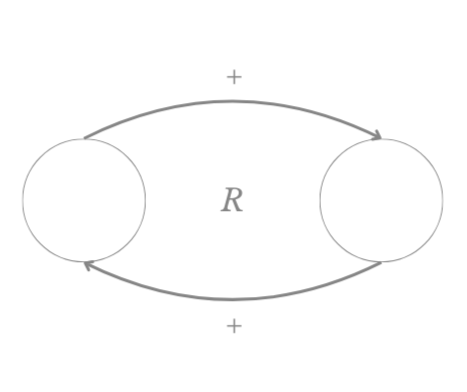
Draw 2 key elements, each in a circle. They could be trends, behaviors, or conditions. Avoid vague or overly broad concepts like “justice” unless they can be clearly defined.
There are two kinds of feedback loops:
Balancing feedback loop (B): Tries to keep things steady or balanced. Like a thermostat, it turns the heater off when it’s too hot. It resists change and brings things back to normal.
Reinforcing feedback loop (R): Makes things grow or shrink faster and faster, like a snowball rolling downhill. It amplifies change and can lead to fast growth or collapse.
Label the loop as B or R to keep track. One variable might be part of multiple loops—that’s normal! Systems are messy but interesting.
Use your feedback loops to spot leverage points and places where a small change can make a big difference.
Based on the ideas of Peter Senge (1990) & Donella Meadows (1992).
Related Building Cards