Stakeholder Map
Understand
Map influence and interest to align stakeholders.
During a rural vaccination campaign, a team used a stakeholder map to figure out who needed to be involved and how. They gave weekly updates to the mayor and the local health director, since both had a lot of influence. A popular local radio host wasn’t very interested at first, but had a big audience, so they invited him to an early vaccination event and answered his questions. Nurses were in charge of rolling out the campaign, so the team shared daily updates to keep them in the loop.
Steps
First, define exactly what you are mapping stakeholders for, whether it’s a product, a project, or a collaboration between teams. Be precise, because everything that follows depends on this definition.
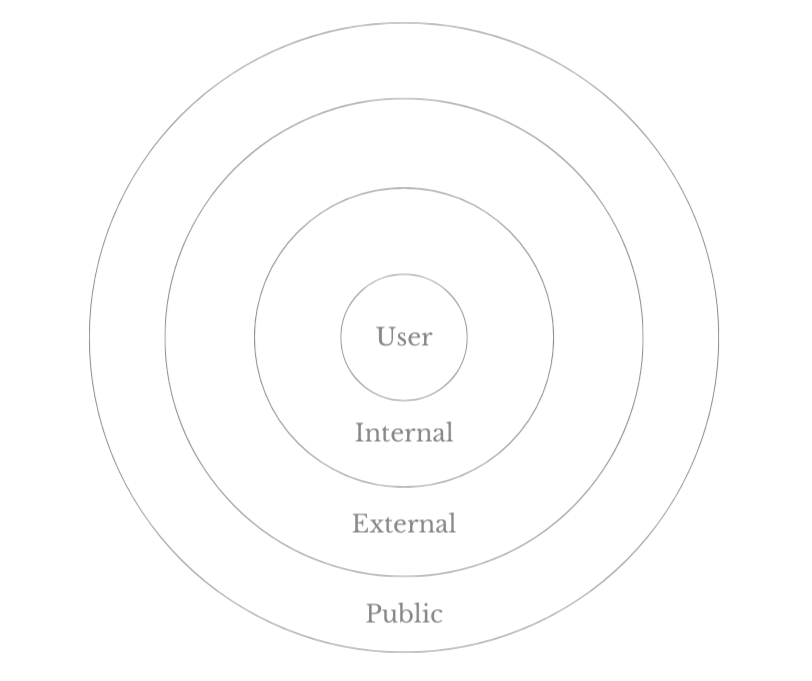
Draw four circles, one for each type of stakeholder group. Write down everyone who is involved, affected, or has influence.
Ask: Who is impacted? Who’s responsible or accountable?
Users are the people who experience the issue or outcome directly. They are the ones most affected by what changes or doesn’t change.
Internal stakeholders are the people or teams who actively shape the issue or outcome, keep it running, or work to solve it.
External stakeholders are people or organizations that interact with the issue from the outside. They may influence it, be influenced by it, or enable or constrain possible solutions.
Public stakeholders include regulators, institutions, communities, and society at large, especially when the issue has social, legal, ethical, or collective implications.
Then draw the connections between them to show how they relate or influence each other. Use different types of lines or symbols if some relationships are more complex than others. Use a line with a question mark for unclear or informal relationships, a solid line for institutional or formal relationships, an arrow to show a directed flow of information, a highlighted line to indicate conflict or tension, and a broken line to represent interrupted relationships.
Look at the map and identify key influencers, risks, and gaps. Use these insights to decide what actions to take next and what consequences to expect when working with these stakeholders.
Based on the ideas of R. Edward Freeman (1980s) and Ronald K. Mitchell, Bradley R. Agle, Donna J. Wood (1997).
Related Building Cards